

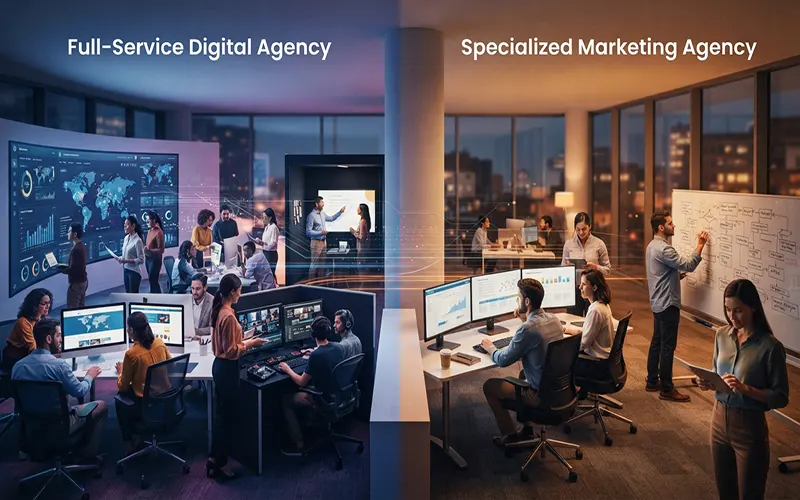
Choosing an external marketing partner often comes down to a fundamental strategic dilemma: should you hire a multi-disciplinary Swiss Army knife or a focused scalpel? While full-service digital agencies manage every channel under one roof, specialized boutique agencies focus intensely on a single domain like search engine optimization (SEO), paid advertising (PPC), or high-end web design. Evaluating how these two models differ across structure, cost, and execution is essential for maximizing your marketing return on investment.
1. The Full-Service Agency Ecosystem
Full-service digital agencies offer comprehensive, multi-channel management, typically handling everything from website development and brand identity to paid media, SEO, and email automation.
- Centralized Coordination: Having a single team manage all digital touchpoints ensures cohesive brand messaging and eliminates the finger-pointing that often happens between separate vendors.
- Cross-Channel Synergies: Insights gathered from paid search campaigns can directly inform organic content strategies, creating an integrated ecosystem.
- Operational Efficiency: Businesses avoid the administrative burden of juggling multiple agency contracts, invoices, and communication loops.
- Potential Pitfalls: Some full-service firms may spread their generalist talent too thin, occasionally lacking the cutting-edge, niche depth required for ultra-competitive sectors.
2. The Specialized Marketing Agency Focus
Specialized agencies operate with laser-like focus, dedicating their entire staff to mastering a single discipline or industry vertical.
- Elite Domain Expertise: Because they concentrate on one craft—such as enterprise SEO or complex Google Ads structures—specialists stay on the absolute cutting edge of industry algorithm changes and advanced testing tactics.
- Senior-Led Execution: Boutique firms frequently feature senior practitioners actively managing accounts rather than routing work through layers of junior account managers.
- Vendor Coordination Friction: If you hire multiple specialists (e.g., separate SEO, social media, and design firms), your internal team must act as the general contractor to keep campaigns aligned, which can introduce communication silos.
3. Dimension Comparison: Cost Structure, Scalability, and Team Quality
Comparing financial commitments and resource allocation highlights clear operational trade-offs:
- Pricing Models: Full-service agencies typically command higher monthly retainers (often starting at $5,000 to $25,000+) because they bundle diverse resources and multi-channel support. Specialized agencies often feature lower entry-level pricing points (ranging from $2,500 to $10,000 monthly), allowing smaller budgets to target specific bottlenecks.
- Scalability: Full-service models scale smoothly as a company grows its marketing mix, whereas managing multiple specialized vendors can become cumbersome as marketing complexity expands.
Decision Framework: Which Model Fits Your Business Stage?
The right choice depends entirely on your current growth bottlenecks and internal bandwidth:
- Choose a Full-Service Agency If: You are executing a complete brand overhaul, launching a new product line across multiple channels simultaneously, or lack the internal bandwidth to coordinate multiple external partners.
- Choose a Specialized Agency If: You have identified one specific channel as your primary growth driver (e.g., fixing a broken paid ads funnel or scaling organic search) and require elite, top-tier expertise to optimize it.
Summary Guidance
Success does not rely on choosing the “best” agency type universally, but rather on matching the agency model to your immediate operational maturity. Align your partnership structure with your primary growth constraint, ensuring your marketing capital addresses your most urgent business bottleneck.